Sunday, September 27, 2009

Philippines battles flood chaos


People cling to debris as they are swept along a river in Marikina. Please Click Here

A massive rescue operation is under way in the Philippines where at least 73 people are confirmed to have been killed in the wake of torrential rains.


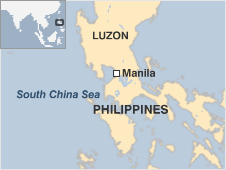
Tropical Storm Ketsana triggered the worst flooding in decades in the capital Manila and nearby provinces.

Defence Secretary Gilbert Teodoro said troops, police and civilian volunteers had rescued more than 4,000 people - many clinging to each other on roofs.

More than 250,000 have been driven from their homes, officials say.

Military chief Gen Victor Ibrado flew by helicopter over suburbs of Manila on Sunday to see for himself drenched survivors marooned on top of half-submerged buses and on rooftops.

TV footage showed some survivors clinging to high-voltage power lines.

Correspondents say the rescue effort is intensifying as the weather cleared on Sunday.

But some reports estimate that 80% of the capital is still under water.

The government has declared a "calamity" in Manila and 25 provinces, allowing access to emergency funds.

Latest confirmed figures say that 73 people are dead and at least 23 others are missing.
One report puts the number of dead and missing at 106.

Manila bus driver George Andrada said he had lost everything in the floods.

"It happened very fast. All of a sudden everything was under water. I was not able to save anything except the shirt I am wearing," he said.

Some residents have emailed the BBC with their experiences. Lovely Lansang in Marikina, near Manila, says: "I am currently seeking refuge in a shopping centre. Many people are stuck either on their roofs or in the second storey of their houses.


Philippines Disaster Council
In pictures: Philippines floods
Eyewitness: Philippines floods

"The city is also without clean water and electricity. Right now, I am still in the shopping centre because the roads here are impassable," the email adds.

The equivalent of a whole month's rain fell in six hours as Ketsana, also known as Ondoy, lashed the northern island of Luzon.

On Saturday, TV images showed gushing water turning roads into rivers, with floods chest-deep and rising.

Appeal for calm

Philippines President Gloria Arroyo appealed for donations and called for calm.

"I am calling on our countrymen, especially residents of metro Manila and other provinces in the path of the typhoon, to please stay calm, follow the instructions of local officials and civil defence authorities," she said in a TV message on Saturday.

Also on Saturday, Mayor Mon Ilagan of the town of Cainta, in Rizal province east of Manila, told local media his town was "almost 100% under water".

Rizal Governor Casimiro Ynares was quoted by local media as saying other towns were completely inundated.

Roads leading into Manila were rendered impassable by stalled vehicles, and some ferry services were cancelled.

The Philippines chief weather forecaster has blamed climate change for the downpours that saw 40cm (16in) of rain fall on Manila in a single day.

Thousands of passengers were stranded as international and domestic airports were shut down.
Ketsana, with winds of up to 100km/h, is expected to head out over the South China Sea on Sunday and Monday.

Source: BBC News.

Madagascar President Prevented from Addressing UN General Assembly

By Margaret Besheer
United Nations
26 September 2009
The U.N. General Assembly annual debate was disrupted late Friday when some African leaders voiced their strong objections to the president of Madagascar making his address. Andry Rajoelina came to power in a military-backed coup last March and his government has been roundly rejected by both the South African Development Community (SADC) and the African Union.


Andry Rajoelina (file photo)

Mr. Rajoelina was supposed to speak on Thursday, but was dropped from the speakers list after objections from SADC.

His name reappeared Friday, but when it was his turn to take the podium, the foreign minister of the Democratic Republic of Congo, Alexis Mwamba, intervened on the behalf of SADC.

"Mr. President, I am taking the floor on behalf of the Southern African Development Community ... under Article 71 and 113 of the General Assembly rules of procedure, SADC would like to express its protest against the decision to invite Mr. Andry Rajoelina to take the floor at the general debate of our August assembly," he said.

He pointed out that both SADC and the African Union have decided not to recognize the Malagasy government of Mr. Rajoelina that came to power in a coup d'etat and that they support mediation efforts to return constitutional order to that country. He said as long as it is not reestablished SADC will not recognize the current government.

"If the floor is, however, given to him, we would like to urge all member states to continue to manifest their support for us by standing and exiting the room. Thank you Mr. President," said Mwamba.

General Assembly President Ali Treki said he was informed Thursday of SADC's objections and said he had been in contact with the U.N.'s legal counsel on the matter.

"There was a representative from the legal counsel who was present at our meeting," he said. "The response of the legal counsel was that the president [of the GA] can defer giving him the floor, but cannot ban giving him the floor, but cannot prohibit him from being given the floor, because he was invited by the United Nations.

"President Treki said he had the power to decide in accordance with the rules of procedure and said Mr. Rajoelina should be given the floor, but that if any state wanted to appeal his decision, they should indicate it immediately and it would be put to a vote.

The members of the General Assembly take a vote on Madagascar during the 64th session at United Nations headquarters, 25 Sep 2009

Minister Mwamba called for a vote, but it was wrapped in confusion, as the delegate from Jamaica expressed the frustration of many of his counterparts.

"I am not sure what it is that we just voted for. And I am totally confused. And many delegations have not yet voted," he said.

The vote was repeated and after yet more confusion it was decided that there were enough votes to keep Mr. Rajoelina off the podium.

It was not clear whether the vote would be deemed final or whether the Madagascar delegation would be given a chance to speak Saturday or Monday, when the assembly's annual general debate ends.

51 Dead, 21 Missing in Philippines Storm

By VOA News

27 September 2009

Officials in the Philippines said Sunday at least 51 people were killed and 21 are missing after a tropical storm tore through Manila and several northern provinces Saturday.
The Philippine government declared a "state of calamity" after Tropical Storm Ketsana dumped nearly a month's worth of rain in just nine hours on the capital and more than 20 provinces.
The storm swept houses away, and hundreds of vehicles were stalled in floodwaters around Manila.
Officials say 1,800 people were forced from their homes into shelters. Some residents were stranded on rooftops waiting for rescue.
There are also reports of widespread blackouts. Hundreds of travelers are stranded in airports and along water routes.

Some information for this report was provided by AFP, AP and Reuters.

Mu Sochua to Appear at Appeal Court Oct 2

Mu Sochua (R) and Sam Rainsy (L) in a candlelight vigil during her defamation trial on 24.7.09: (Picture by PPPost)

Written by DAP NEWS
Sunday, 27 September 2009
Mu Sochua, the Sam Rainsy Party (SRP) lawmaker, will appear at the Appeal Court on October 2, according to the Appeal Court's summon signed by the court prosecutor general summon on September 23. The appeal court's summon was made two days after Mu Sochua arrived Cambodia from a visit to the US.Mu Sochua’s appearance is related to her appeal over the verdict in a defamation case with Prime Minister Hun Sen.
Ouk Savuth, the appeal court prosecutor general, on Saturday told DAP News Cambodia that he would question Mu Sochua about the case with the premier.
Ky Tech, the premier’s lawyer, said that he has so far not received any notification of the upcoming case.
The lawyer has already stated he is ready to face Mu Sochua at the Appeal Court or Supreme Court if she chooses to challenge the August 4, 2009, ruling of the Phnom Penh court.
Mu Sochua could not be reached for comment on Saturday. Mu Sochua had dodged a small crowd of around 10 waiting journalists upon her arrival at Phnom Penh International Airport as she was escorted through the VIP gate.
Mu Sochua’s actions have puzzled some of the Cambodian reporters given her recent scathing criticisms of democracy and human rights in Cambodia during her trip to the US.

A New Effort Cracks Down on Americans Who Travel Abroad to Have Sex with Children

By Ben Tracy


The long captivity of Jaycee Duggard has many wondering how sex offenders are able to go unnoticed. As Ben Tracy reports, some offenders are accused of going to great lengths to commit their crimes.

Photo
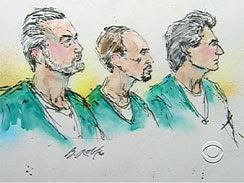
A courtroom sketch of three convicted sex offenders from California who were arraigned in federal court as part of Operation Twisted Traveler. (CBS)

(CBS) This week in Los Angeles, three convicted sex offenders from California were arraigned in federal court - the first Americans arrested in an international law enforcement crackdown called Operation Twisted Traveler. They are accused of traveling to Cambodia to have sex with children.

"Pedophiles are sadly mistaken if they think they can get away with exploiting children in another country in order to satisfy their own perverted desires," said U.S. Attorney Tom O'Brien.

Jack Sporich, 75, is one of California's most dangerous sexual predators. He served nine years in prison, but in 2008 traveled to Cambodia.

According to the criminal complaint, Sporich would drive through poor towns throwing money and candy. He is accused with having sex with three boys, ages 9 to 13.

"The trauma they have endured is unimaginable and will haunt them for the rest of their lives," said Jeffrey Blom with the International Justice Mission.

Tough laws here requiring convicted sex offenders to register are sending them into hiding, to remote spots like Antioch, Calif. where Phillip Garrido hid Jaycee Duggard for 18 years. Some go much farther.

"I think sex offender registries as a whole are generally great in terms of monitoring. However there are unintended consequences," said Robin Sax, author of "Predators and Child Molesters" and a former prosecutor. "By driving people out of cities and into more rural areas we are again losing contact and not knowing where these people are.

"Overall, an estimated 2 million children worldwide are exploited in sex industries, reports CBS News correspondent Ben Tracy. Thailand, Cambodia and Costa Rica are popular destinations for sex tourists because laws are weakly enforced and sex is cheap and readily available.

The three men arrested in Operation Twisted Traveler will be tried in November and face 30 years in prison for each of their victims.

Source: khmerization.

Pope Benedict Urges Czechs to Rediscover Christian Roots

By Stefan Bos
Budapest

Pope Benedict XVI and Czech cardinal Miloslav Vlk greet well-wishers as Pope visits 'Church of Our Lady Victorious' in Prague, 26 Sep 2009


Pope Benedict XVI began a three day visit to the Czech Republic with a call for the nation to rediscover its Christian roots. Forty years of communist rule in the country stifled religious activities and left the number of Catholics in decline and religious practice in general at historic lows.
The 82-year old pontiff urged Czechs to rediscover their Christian roots.
Under communism, which ended with the 1989 Velvet Revolution, the church was repressed.
Research shows that today nearly half of the country's population of 10 million claim to be non-believers.
Speaking in Czech, the pope said the Roman Catholic Church has been battered by four decades of totalitarian rule until the fall of communism.
The pontiff explains that the cost of 40 years of political repression when church leaders were imprisoned and Christians harassed is "not to be underestimated." He says that "a particular tragedy" for the Czech Republic was what he calls "the ruthless attempt by the government of that time to silence the voice of the church." He says now that religious freedom has been restored, all the citizens of the Czech Republic should "rediscover the Christian traditions which have shaped their culture.
" Speaking at the same ceremony, Czech President Vaclav Klaus made clear that despite Czech distrust toward religion, the pope should feel welcomed.
Mr. Klaus says he welcomes the pontiff in Prague and the Czech Republic from all of his heart. And he hastens to add that he does not only speak for himself or his wife "but on behalf of all Czechs."
The pope's attempts to increase public confidence in the Catholic Church are overshadowed by several disputes, including the return of church properties that were confiscated by the Communist regime in 1948.
An enduring symbol of that struggle is the 14th-century St. Vitus Cathedral, the Gothic centerpiece of Prague's medieval Hradcany Castle. Two decades after the collapse of communism, the church is still fighting to recover it from the government.
The papal's envoy in the Czech Republic, Archbishop Diego Causero, has told Vatican Radio that the Catholic Church also seeks the return, or compensation, for mainly rural properties, including forests.
"Practically for 50 years it has been taken from the church and it has been used by the state. The church does not want to receive back what is lost during the period. We would like only want the of properties or compensation where properties can not be identified anymore or can not be given back because something is build on that."
Among his first scheduled appointments Saturday was a visit to the Church of Our Lady of Victory in Prague, which holds a statue of the Infant Jesus and has become a magnet for worshippers from around the world.
Father Renzi, a monk from India assigned to the church, described the pope's arrival at the site as historic.
"We are very excited because the father of the Catholic Church is visiting this church. And this is the first time that any pope visits this church," he said. "This is the original shrine of Infant Jesus. And the pope visiting this shrine of Infant Jesus means that he is reaching out to all the shrines that are in the world which are dedicated to the Infant Jesus."
Czech organizers hope the pope's visit will encourage 100,000 Catholic faithful, including pilgrims from neighboring Austria and Poland, to pack an airfield for Sunday's outdoor Mass in the town of Brno.
The gathering has been described as "the highlight" of the pontiff's three-day pilgrimage in the Czech Republic.
Source: voanews.

Viettel prospers in Cambodia market

HA NOI — Viet Nam’s Military Telecom Corporation (Viettel) is now the largest telecommunications service provider in Cambodia, after launching its Metfone mobile service network in the Kingdom six months ago.

Metfone currently accounts for 60 per cent of all ADSL services and 50 per cent of the fixed phone market. It has 2 million mobile subscribers, ranking second among nine mobile service providers in Cambodia.

To facilitate the Cambodian people’s access to fundamental telecommunications services, Metfone has reduced its mobile service charges from 11 cents per minute to 9 cents per minute, and expects to adjust it down even further in the near future.

Additionally, Metfone is the sole provider of all telecommunications services in Cambodia, with its product distribution network covering even the most remote and isolated communes. It is also the sole provider of wireless fixed phone services, with nearly 20,000 subscribers in the country.

Along with business development in Cambodia, Viettel has invested US$5 million to carry out a three-year programme to introduce the internet to schools, subsidised 50 per cent of wireless fixed and mobile phone charges for poor people and sponsored an online television system, connecting the Government to localities across the country.

Metfone is expected to earn revenue of $50 million this year and provide 3G services in Cambodia early next year.

Metfone is also expected to have 2.6 million mobile subscribers and 3,000 transceiver stations covering all 24 provinces and cities of Cambodia, and the ability to provide affordable, high-quality services for customers by 2010. — VNS
Source: Click Here

1,500 U.S soldiers to join military exercise in Cambodia next year

About 1,500 U.S. military men are expected to join military exercise which is planned to take place in Cambodia in the middle of next year, Cambodian military official said Saturday.
Gen. Chhum Socheat, spokesman of National Defense said that more than 2,000 military men are reserved for the first-ever event in the country and they will come from more than 20 countries, of which 1,500 will be from the United States.
The military exercise which is to be supported by the United States under a program titled "Global Peace Operations Initiative or GPOI" will take place in June or July next year.
According to the plan, the military exercise will be conducted in Phnom Penh and in Phnom Sruoch district in Kompong Speu province, about 90 kilometers from the capital, the officials added.
On Wednesday, the U.S. Embassy in Phnom Penh issued a statement saying during a four-day visit to Washington D.C. , Tea Banh, Cambodia's Deputy Prime Minister and Minister of National Defense had met with U.S. Deputy Secretary of State James Steinberg and discussed security cooperation between the United States and Cambodia.
During the meeting, they also highlighted Cambodia's ongoing support for international peacekeeping operations and Cambodia's commitment to hosting the 2010 Global Peace Operations Initiative (GPOI) regional capstone exercise.
GPOI is a U.S.-funded G-8 program to expand global capacity to train and equip 75,000 peacekeepers by the year 2010, the statement said.
Peace Operations Initiative was established after the 2004 G8 Sea Island Summit to address growing gaps in international peace operations. The goals of GPOI expand upon the goals of the Sea Island Action Plan. GPOI built policy based on previous peace operations capacity-building programs.
Source: Xinhua

Cambodia calls for successful conclusion of trade talks

Cambodia on Saturday called for the successful conclusion of the Doha Round negotiations to help mitigate the impact of the world economic and financial crisis on developing countries.
Cambodia's Deputy Prime Minister Hor Namhong made the statement as he addressed the general debate of the UN General Assembly at UN Headquarters.
While the developed countries have more possibilities and resources to cope with the economic slowdown, the developing countries have suffered the most with a huge loss of national income, he said.
The economic growth of developing countries is expected to fall sharply due to a drastic reduction in export which they have largely been dependent on, to the falling of investment, and to the rising unemployment, he said.
"In order to help mitigate the impact of this economic and financial disaster on developing countries, I am of the view that we should do everything possible to get the Doha Round negotiation back on track for a successful conclusion in order to break down barriers to trade, to better market access, particularly in agricultural goods, and to reduce agricultural subsidies," he said.
He welcomed the recent commitment of G20 made in Pittsburg to bringing the Doha Round to a successful conclusion in 2010.
The Monterrey Consensus should be invigorated in order to help developing countries to alleviate poverty and meet the Millennium Development Goals(MDGs), he added.
Source: Xinhua

Cambodia to send 42 peacekeeping forces to Central African Republic and Chad: officials

Cambodia will dispatch 42 peacekeeping forces to Central African Republic and Chad under the peacekeeping mission of the United Nations, the local media said on Sunday.
"Our forces will depart for these countries in November after Prime Minister agreed to send our soldiers," DAP News quoted Nhim Savat, director general for general department of politics and international relations of Ministry of National Defense, as saying.
"And in earlier mid-2010, we will send other 80 armed forces of light engineering Unit for the two countries under the U.N. peacekeeping mission," he added.
Cambodia and the U.N. have already signed on MOU of deploying the peacekeeping armed forces in Chad and Central African Republic," he said.
"The UN side will not send their monitors to train our armed forces for this time after they have confidence in the abilities and capacities of forces training and our experiences in previous times," said Sem Sovanny, director general of the national center for peacekeeping forces management, mine clearance, unexploded ordnance waste of post war.
"Five senior military officials from National Defense Ministry will also accompany our Royal Cambodian Armed Forces (RCAF) to these countries," Sem said.
Cambodia is used to take part in joint military exercises in several countries, such as Indonesia, Mongolia, Bangladesh, and also Sudan's de-mining activities under the U.N. peacekeeping mission.
Cambodia will also host the military exercise which is to be supported by the United States under a program titled "Global Peace Operations Initiative or GPOI" which will take place in June or July in 2010.
Source: Xinhua

Iran Tests Missiles in War Games

By VOA News

Iranian media say the Islamic Republic has tested two short-range missiles and plans to test a long-range weapon believed to be capable of reaching Israel.
State television says the elite Revolutionary Guard also tested a multiple missile launcher Sunday at the start of their regular war games.
The long-range missile test is scheduled for Monday.
The military exercises are happening as tension is rising between Iran and Western nations over Tehran's controversial nuclear program.
Iran revealed this past week that it is building a second uranium enrichment plant, despite the United Nations' demands that it stop processing material used in nuclear bombs.
A senior U.S. official says the Obama administration plans to tell Iran this week that it must open up the facility, turn over documents and provide access to key players in Tehran's nuclear program.
Iran's nuclear chief, Ali Akbar Salehi, has told Iranian state television inspectors will be allowed to visit the site near the Shi'ite holy city of Qom.
Iranian officials will discuss their nuclear program in Geneva Thursday with diplomats from the U.S., Britain, France, Germany, Russia and China.
The U.S. and its allies have accused Iran of developing a nuclear weapon, a claim Tehran denies.
Some information for this report was provided by AFP, AP.

World Powers To Demand 'Unfettered Access' to Iran Nuclear Site

By VOA News

French President Nicolas Sarkozy, flanked by President Barack Obama, and British Prime Minister Gordon Brown, makes a statement on Iran's nuclear facility

The United States and five other world powers are planning to demand what they call "unfettered access" to Iran's new nuclear facility.

A senior U.S. official, who refused to be named, says the United States and other world powers will also demand Iran turn over within weeks other information it has been withholding on its nuclear program.

Diplomats from the U.S. and the five other powers - Britain, France, Germany, Russia and China - are scheduled to meet with an Iranian delegation in Geneva Tuesday.

But even as world powers increase the pressure on Iran about its nuclear ambitions, Iran's president is refusing to back down.

President Mahmoud Ahmadinejad told reporters in Tehran Saturday that the U.S. and its allies already regret rebuking Iran over the facility's existence.


Iranian President Mahmoud Ahmadinejad (L) gestures to Mohammad Mohammadi-Golpayegani as they arrive for Friday prayers at Tehran University, 28 Aug 2009

He also said the revelation of the second facility for enriching uranium struck a "blow" against Western powers.

The U.S., Britain and France accuse Iran of building the nuclear facility in secret - a charge Iran denies.

During his weekly address Saturday, U.S. President Barack Obama criticized Iran for a "disturbing pattern" of evasion, but said he is open to "meaningful dialogue.

"Mr. Obama also told Tehran it must cooperate fully with the International Atomic Energy Agency and allow inspectors to visit the site near the Shi'ite holy city of Qom.

Iran's nuclear chief, Ali Akbar Salehi, told Iranian state television Saturday that inspectors will be allowed to visit.

A top aide to Iran's supreme leader said the uranium enrichment facility should be operational soon.

The United States and its allies accuse Iran of working to produce a nuclear weapon. Iran says its atomic program is for peaceful purposes, to generate electric power.

Some information for this report was provided by AFP, AP and Reuters.

Okada to visit Cambodia next week to meet Mekong foreign ministers

TOKYO — Foreign Minister Katsuya Okada will make a two-day visit to Cambodia from Oct 2 to attend a foreign ministerial meeting between Japan and five Mekong region countries, the Japanese Foreign Ministry said Friday in a press release.

While attending the Oct 3 Japan-Mekong Foreign Ministers’ Meeting in Siem Reap in northwestern Cambodia, Okada is also expected to hold bilateral talks on the sidelines with his counterparts from the other countries attending the meeting, possibly including Myanmar.
Source: everyday

CAMBODIA: KHMER ROUGE TRIBUNAL ENDS TESTIMONY

Robert Carmichael

PHNOM PENH (IPS) - After 72 days of hearings, the first international trial of a Khmer Rouge regime member has wrapped up its often horrific testimony in the Cambodian capital.
Comrade Duch (pictured), whose real name is Kaing Guek Eav, has sat placidly in the dock since proceedings began in late March, as the court unravelled his meticulous supervision of at least 15,000 murders while he headed the main Khmer Rouge torture centre, known as S-21, in the 1970s.
Although Duch has repeatedly apologised to victims, many Cambodians do not believe his expressions of remorse are genuine. Despite that he did so again on the penultimate day of testimony.
"I would like to apologise," he told the court. "I would like to seek forgiveness from the families of the victims.
"But while Duch admits to the charges of war crimes and crimes against humanity, he has also continually pleaded that he was a mere functionary in a much bigger system. He said he had no choice but to follow the orders handed down from his superiors to execute S-21?s inmates by sending them to the Killing Fields at Chhoeung Ek outside Phnom Penh.
"The only way to survive was to fulfil the duties assigned to us ? so I tried to survive on a daily basis," Duch told the court during the final week of testimony.
Duch has repeatedly insisted he did not personally arrest, torture or kill anyone, and told the court that suspected "enemies" of the revolution simply had to be killed. Anyone who was arrested was by default guilty, and the function of prisons like S-21 was to extract a confession before killing them.
Many people have expressed hope that the trial will offer some relief and answers to the events that consumed Cambodia between 1975 and 1979. Two million people are thought to have died from execution, starvation and overwork in the brutal four years of Khmer Rouge rule.
Prosecutors used the proceedings to accuse him of operating S-21, one of nearly 200 detention centres around the country, with uncommonly ruthless efficiency.Powerful testimony from witnesses, recounting their harrowing experiences, has echoed those of the many more who were enslaved around the country.
Bou Meng, 68, told the court how he became one of the handful of prisoners who survived S-21. Duch had heard Bou Meng was an artist, so he put him to work painting huge propaganda portraits of Pol Pot and other senior Khmer Rouge leaders.
The former prisoner?s wife, who was arrested with him, disappeared and was killed at S-21. His emotional testimony described how he was beaten with sticks by S-21 interrogators, who accused him of spying for America and the Soviet Union, common charges under an increasingly paranoid regime.
"Every time they beat me, they asked me questions: ?Who introduced you into the CIA (the U.S.?s Central Intelligence Agency)? What was their name??" Bou Meng told the court in July, breaking down in tears. "I responded that I did not know ? I gave the same response."
"I could not think of any mistakes I had made," he said. "I did not know of any KGB (Russia?s former national security agency) or CIA network. They just kept beating me up.
"Duch admitted to the tribunal that most confessions, which were extracted from each prisoner through beatings, electrocution and even the removal of toenails, were untrue. He told the court a number of times that in ordering the executions, he was simply following orders.
"The decision of the Party was overwhelming," he told the court on the penultimate day of testimony on Sep. 16 as he described how he had his brother-in-law arrested, tortured and then executed. "Nobody could stand in its way. . . . I was an ordinary party member. I had no right to protest.
"The damage wrought by the Khmer Rouge was felt mainly in Cambodia, but the trial also showed how the effects of the regime?s murders rippled around the world to terrible effect.
The court heard from a French woman whose Cambodian diplomat husband returned to the country in 1977 and was murdered at S-21, and a New Zealand sportsman whose brother was taken from his yacht, which had strayed into Cambodian waters, and eventually killed.
Duch?s guilt is not in question ? the key unknown is what sentence will be levied on him. (Cambodia does not have the death penalty.)
Final arguments in the trial will take place at the end of November, and judges are expected to hand down their verdict in 2010.
Duch?s defence has indicated its belief that judges should take into account his numerous apologies and admissions of guilt, as well as the fact that he spent a decade in detention before his trial.
But whether Duch?s remorse is genuine ? which many Cambodians doubt ? the fact that he has apologised is important to some, such as former S-21 survivor Chum Mey, 79.
Chum Mey told the court during his testimony in June that five of his children died under the Khmer Rouge. When he finally returned to his village, just two relatives were still alive there. Despite being tortured at S-21, Chum Mey said ? in a video recorded before the trial began and shown by the defence on the penultimate day of the trial ? that he bears no grudge against Duch.
"Before I was not free to speak out as I am doing now," he said in the video, which was filmed at S-21 in February 2008 when Duch, who broke down in tears at the prison, returned there and apologised to the nation. "I thank Duch for coming to give testimony. . . . I would ask him to speak the truth before the court.
"Duch claims to have done that despite some significant inconsistencies in his statements such as refuting the testimony of some parties who said they saw him torture or kill people. But even he admits that saving himself by carrying out the killings of so many thousands of others was fundamentally dishonourable.
"Yes, you can say I am a coward," Duch told the court in the final week of testimony.

Today, there are not as many tri-cycle-vehicle (Cyclo in French) drivers as in the past. According to Research Center of Cyclo, such vehicles are 50 percent reduced, compared with the number in 2004. The reason is that now there are plenty of transports, which are popular among most passengers and are faster than Cyclo.
Source: everyday

NGOs Weigh in on RFA Dismissals

Written by DAP NEWS

Some NGOs working in Cambodia on Saturday made comments suppor- tive of workers fired by Radio Free Asia (RFA), calling the dismissals unjust and unreasonable.
According to an RFA source, Phan Sophat is now the fifth worker to be fired by the RFA management in Phnom Penh after Huy Vannak, Seang Sorphorn, Thai Sothea, and Mean Rith. Chea Mony, Cambodian Free Trade Union President, on Saturday told DAP News Cambodia that he has received complaints from the fired workers. He said he would strive to whether the dismissals were legal or not. “According to the labor law, if any worker is employed for more than two years, firing them can only be done if they have made mistakes,” said Chea Mony. “Any firing without reason is said to be illegal.”

Rong Chhun, Cambodia Indepen- dent Teacher Union President, said that he will investigate this case. He said the workers should be provided with compensation. “If those workers need help from us, we will intervene in this case,” he added. Ou Virak, Cambodian Center for Human Rights Director, said he was disappointed such experienced and educated workers were fired. “I regret for what RFA, which is very popular among Cambodian listeners, has done. They should find good solutions to share and balance benefits,” he told DAP News Cambo- dia on Saturday. He also promised to investigate the case.
Four well-respected reporters from Radio Free Asia (RFA) on Friday evening protested by burning tires in front of the RFA main office in Phnom Penh.
The four reporters, Huy Vannak, Seang Sorphaorn, Thai Sothea, and Phan Sophat said they demonstrated following the decision by the director, Kem Sos, to fire Huy Vannak and Thai Sothea.
Both Huy Vannak and Thai Sothea opposed the dismissal of Seang Sorphaorn, saying it was “due to revenge and abuse of internal regulations.” Thai Sothea said that he had been fired illegally. Kem Sos declined to comment on the matter, asking that questions be sent to the RFA main office in Washington DC in the US. The protesters iterated that they will send a statement to the US embassy in Phnom Penh if there is no solution. The US embassy officials in Phnom Penh will call those fired workers to clarify more details on Monday next week, according to the source from US embassy.

Cambodia Spend US$6 Million Annually on Prisoners’ Food: Official

The Cambodian Government last year spent about US$6 million for to feed over 22,000 prison inmates across the country, Interior Ministry spok-esman Khieu Sopheak told DAP News Cambodia on Friday.

The figure is equal to CR2,800 (about US$0.70) per prisoner per day for food, he said a press conference at the ministry.

He called the sum “a heavy matter for the Government.”

“We also are improving the living conditions of those prisoners and inmates,” he said, adding that authorities had also increased the food allowances.

“We do not want to see anyone to be arrested and sentenced by the court and but they committed the crimes by their own choice, so finally they were sent to jail,” Khieu Sopheak said. Cambodia currently has a total of over 22,000 prisoners in 22 jails across the kingdom, he said. “Now we are facing gangsters and so far this year our police authorities arrested 1,590 gangsters across the country to educate about morality and imprison them,” he added.

Of those, 454, including 76 women, have been sent to the court, he said. The suspects were changed with drugs offenses, robbery, destroying private and state properties, disturbing other neighboring people, and “their acts created the disorder security in the society,” the Interior Ministry spokesman said.

Cambodian gangsters have not so far been led by a centralized system of leadership, like the mafia in foreign countries, Keat Chantharith, spokesman for Cambodian National Police Commission, told reporters at the press conference.

Local people, village chiefs, and commune councilors in communities must report crimes to police to prevent gangsters gaining control of areas, he said.

Source: dap-news.com

Fired RFA Staff Seek US Ambassador Intervention

Click Here

Saturday, September 26, 2009

School daze

Rong Chhun, president of the Cambodian Independent Teachers Association, confronts riot police deployed Thursday to monitor a protest by first-year students from the University of Health Sciences who say the school is cheating them by preventing hundreds who failed their exams from continuing on to their second-year studies.

Full Story Read Below!


Students appeal to PM in exam feud

SEVERAL hundred first-year students of Phnom Penh’s University of Health Sciences continued to rally in front of their school on Thursday, calling on Prime Minister Hun Sen to intervene in their dispute with university administrators who have blocked them from enrolling in a second year of studies.

Rong Chhun, president of the Cambodian Independent Teachers Association, said around half of the 2,000 students had been blocked from re-enrolling after failing their exams, but that 70 percent of those rejected wished to advance to the second year despite their results.

Peng Sofina, a 20-year-old freshman, said his exam results were never released, accusing the school of cheating him to keep second-year class numbers down.

“[The school] delayed my exams several times and did not release [my] scores,” he said.

However, Phay Siphan, spokesman for the Council of Ministers, said that there was no other option but for the students to retake their first-year exams.

“We respect their honour and reputation, and are allowing them to retake the exam,” he said Thursday.

Source: Phnom Penh Post.

Government officials dismiss threat of protest

By Vong Sokheng
The Phnom Penh Post

GOVERNMENT officials dismissed Thai protesters’ threats to hold more demonstrations at Preah Vihear temple after violent clashes erupted between Thai police and protesters on Saturday, and lauded Thai efforts to keep a tight rein on the weekend’s demonstrations.

Photo by: Chris Kelly
Cambodian soldiers remain on standby Saturday following clashes between Thai protesters, villagers and riot police in Thailand’s Sisaket province.

On Saturday, 5,000 yellow-shirted protesters from the People’s Alliance for Democracy (PAD) converged on Thailand’s Sisaket province to protest Thai government inaction over the 11th-century ruins, claiming that Cambodia has infringed on a 4.6-square-kilometre disputed area surrounding the temple

Dozens were injured as protesters fought Thai riot
police and villagers who attempted to block their way.

Chhum Socheat, spokesman for the Ministry of Defence, said that the Thai government’s efforts to prevent protesters from entering disputed areas along the border showed its dedication to a peaceful bilateral solution to the dispute.

“We learned from the protest that our government’s win-win policy to resolve the border dispute through peaceful negotiations has been recognised by the Thai government,” he said.

“During the [protest], I received many phone calls from the Thai authorities in Sisaket province asking me to send a message to Prime Minister Hun Sen not to worry because they were not allowing the protesters to intrude into
Cambodian territory.”

Foreign Ministry spokesman Koy Kuong said Sunday that
police had been deployed at the
temple during the protests. “But we’re not worried at all because the Thai government said they would handle it and prevent the protesters from entering the
temple,” he said.

Chhum Socheat said that according to military reports, three Yellow Shirts were killed and 41 injured in clashes, after Thai locals refused to open hotels or sell petrol to them.

But PAD leaders have vowed to keep up their pressure over the temple, threatening future protests if Bangkok does not reassert Thai sovereignty in the area. “We do not accept the World Heritage Committee’s decision to grant Cambodia the right to list the Preah Vihear temple as well as land around it as a World Heritage site,” said a statement read out by PAD protest leader Veera Somkwamkid on Sunday.

“The government and army should do everything under the law to regain the area around the temple for Thailand.”

Srey Doek, commander of Royal Cambodian Armed Forces Brigade 12, stationed at thetemple, said the PAD was politically isolated, and that further protests were useless.

“Our armed forces are not concerned about any future threats of demonstrations by Thai Yellow Shirts,” he said.

“We are determined to obey the orders of Prime Minister Hun Sen to defend the territory, to prevent the loss of even one millimetre.”

Thai Defence Minister Prawit Wongsuwon echoed the Cambodian sentiment on Monday, according to the Bangkok Post, which quoted him as saying that “both governments have always been closely working together” on the border issue.

Philippine floods claim lives

At least nine people are reported dead or missing in massive floods in the Philippine capital as a tropical storm lashed the eastern side of the country.

A wall, weakened by floodwaters, collapsed in a suburb of Manila, killing a father and child.

Four children drowned in a flood while three others were swept away by a swollen river outside the capital.

Flooding has been reported in many districts with water in some areas reaching as high as the rooftops of one-storey buildings.

700 people have fled their homes and taken refuge in evacuation centres due to rising waters.

Source: Radio Australia News

* Prasat Preah Vihear Mear Taam Chraek

Please click on Khmer poem to zoom in. Khmer poem by Vichea Sam (on the web athttp://kamnapkumnou.blogspot.com/)

Hop on Cambodia’s (very) light rail


Stephen Kurczy
The National (United Arab Emirates)

The flight
Return flights from Abu Dhabi to Phnom Penh on Singapore Airlines (www.singaporeair.com) cost from
US$815 (Dh2,995), including taxesThe ride Roundtrip journeys (about 20km) on the bamboo train cost
between $6 (Dh22) and $10 (Dh37), depending on your bargaining skills
The guide
While technically illegal, most hotels and tour operators in Battambang still organise trips to the bamboo
train lines. Gecko Trails offers guide services and rents motorbikes for $8 (Dh30) per day, for those who
wish to travel on their own to the station, which is situated about four kilometres outside of town.
Thy Racky, a private guide (00 855 17 829 450) is knowledgeable, and speaks English fluently

Their driver winds a rope tightly around the motor and pull-starts the engine. As they accelerate away, Soung and Vat reassemble our car. Soung climbs aboard the rear railing and wraps a fan belt over a motor gear – the other end of the belt is already looped around the axle through a hole in the bamboo platform. He pull-starts the engine and we’re off. The breeze cuts the humidity and clouds of multicoloured butterflies flutter past.
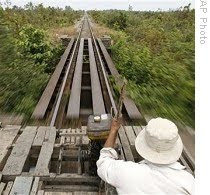
As we hurtle down Cambodia’s decrepit train tracks on a bamboo platform the size of a billiards table, another car rushes in our direction, crammed with 17 passengers returning from marshy rice fields after a day of labour. Their trouser legs are still wet.
Green rice fields stretch out on either side. This is public transportation in parts of Cambodia, and it has become one of the the biggest tourism draw in Battambang, a town a few hours south-west of the temples of Angkor Wat.
Decades of slow and unreliable train service prompted Cambodians to make their own use of the tracks and hundreds of illegal “bamboo trains” now run along the single-lane, 596km-line, that begins near the Thai border in north-west Cambodia, extends east through Battambang to Phnom Penh, then runs south to the coastal port of Sihanoukville.
“There’s only one in the whole world,” a Battambang tour guide, known as Tap Tin Tin says, while escorting a Dutch family of five along the bamboo railway. “You see it transporting tourists, but it’s very useful for the Cambodians to carry rice or bring a cow or pig to slaughter in town.”
In Battambang about 100 tourists ride the cars daily, and hotels and tour guides all advertise rides on the renegade railway. Soon, however, their voyages along Cambodia’s makeshift railroad will end.
An ongoing, five-year, US$148 million (Dh544m) railway project aims to reclaim Cambodia’s tracks from disrepair and connect them to Singapore. De-mining and emergency repair work began in early 2008, and new tracks are expected to go down in November, according to Nida Ouk, an official with the Asian Development Bank, the project’s primary donor. In July, an Australian company, Toll Group, signed a concession to manage Cambodia’s rails.
In addition to increasing freight traffic and quadrupling current train speeds, Ouk says that the project’s funders plan to enforce the ban on the illegal bamboo cars, citing safety concerns and promising to provide alternative skills training to those who operate them.
“You can imagine, it could cause a major traffic accident,” he says.
As we speed toward the opposing car, my 19-year-old driver, Soung Vy, and his co-conductor, Vat Vy, 16, sit calmly atop the platform’s rear railing. Each has a pierced ear – Vat also has nose, lip and tongue piercings. Soung lifts his leg off our five-horsepower engine and pushes his foot down on a piece of wood suspended above the wheels to stop us from running into the car loaded with rice farmers. Five people sit on our cart, compared to 17 on the opposing cart, so we are obligated to disassemble and allow the other to pass.
When opposing cars hold equal loads, drivers decide who disembarks with a game of rock, paper, scissors. We deboard. Soung and Vat grudgingly walk to either side of our platform. They easily pick it up and set it in the brush. Each then lifts a set of wheels, hoisting the axle like a barbell, and sets it aside.
On the other car, Duk Kun, 40, is waiting to go home after a long day planting rice seeds on his one-hectare plot of land. He wears a cowboy hat and smokes a cigarette. Because his field is 15km from the nearest paved road, he rides the bamboo train every day during planting and harvesting season. Without it, he says, he would walk two hours to work. Beside him sits 10-year-old Ho Makara, riding home after visiting relatives down the line.
I had wanted to ride a real train, but when I arrived at the stately old colonial station in Cambodia’s capital, Phnom Penh, I found the gates locked. The landmark building last filled its atrium corridors when a nightclub hosted a dance party there earlier this year. The afternoon I visited, a few squatters slept on the floor.
Ouk Ourk, an official with the Royal Railways of Cambodia, told me that passenger services stopped last year because of the poor state of the tracks. Freight trains derail occasionally, he said, and petrol cars have tipped and spilt.
“We were worried about derailment, about someone dying – we haven’t had this, but we wanted to prevent accidents,” he said. Behind his office at the Phnom Penh station sat dozens of abandoned freight cars and several abandoned passenger cars. Holes dotted the floors and ceiling, broken seats rested in piles, and mounds of human faeces were scattered on the floor, vestiges from the poor who now live in the cars. Freight trains leave for Battambang about once a week and eke along the tracks at 10 to 20km-per-hour, said Ouk Ourk, creeping at a pace that gives bamboo operators adequate time to get out of the way or attempt to outrun it.
Ouk Ourk said the only way civilians ride the tracks is on a bamboo cart, and the best place to do it is in Battambang. Five days later, I arrived at the main train station in Battambang, another decaying colonial building and reminder of Cambodia’s history as a protectorate from 1863 to 1954 of the French, who built these tracks and buildings in the 1930s. Once again, the doors were locked.
A dozen children, aged two to 12, sat on the station’s windowsills and slid their flip-flops along the floor in a rudimentary game of marbles. Cows grazed beside the rails. Two volleyball nets were strung on grassy patches between the tracks.
As I waited for a bamboo train to pick me up, my guide and translator, Thy Racky, 36, got a call from our driver saying police would not let him enter town. Operators are forbidden from entering inner-city stations, although we’d convinced our driver to attempt to sneak in.
Instead, a tourist’s trip along the rail starts about four kilometres outside Battambang town, at the end of a winding dirt road in O Dambong village. Bamboo platforms are stacked on the ground outside another abandoned train station. A young man sells bubble tea for $0.25 (Dh1) from a mobile cart out front.
There is no ticket counter. Taped to the back of the building’s door is a piece of paper listing the names of train operators who share business on a rotating schedule. Cambodians pay about 25 cents for a one-way ride while foreigners pay about $10 for a trip 10km up the line to O Sra Lav village and back.
One traveller, 60-year-old Vive Armstrong from New Zealand, boarded a bamboo train without hesitation. “It looks smoother than the roads,” she said, referring to Cambodia’s notoriously bumpy streets.
After we let the horde of day labourers pass, I am seated cross-legged with two other passengers as we thump over the warped tracks. An emaciated cow occasionally meanders over the tracks.
Looking down as we cross a river I see pieces of cement missing from the 80-year-old bridge. I clench my jaw as we jump gaps in the tracks that are six centimetres long. I ask my guide, Thy Racky, if anyone is ever injured. He says six tourists were hospitalised last year when their bamboo train hit a bump and flipped off its wheels.
Railway officials have long utilised similar carts, but without engines, to inspect the tracks. Civilians began using the carts in the early 1980s after the fall of the Khmer Rouge, the radical communist regime that killed some 1.5 million Cambodians and left the country’s economy and infrastructure in disrepair.
Our bamboo train slows to a stop at O Sra Lav station, where I meet Pat Oun, 69. He owns a beverage shop catering to tourists, but he also says he built 200 engineless lorries before packing up his chisel and axe in 1983. Each took about four days’ labour, he says.
In those days, the operator pushed the cars forward with two long oars – like a gondolier. In 1992, according to local lore, a man named Mr Rit, now deceased, strapped an irrigation pump engine on the cart, creating the first motor-powered bamboo car.
“Everyone just thought a bamboo train would be very useful to transport things from here to there,” says Pat Oun. Today, a bamboo train sells for about $600 (Dh2,204), he says. The platform and engine each cost about $200 (Dh735), and the wheels, salvaged from the gears of old bulldozers and army tanks, cost about $180 (Dh660).
About 200 bamboo train operators work the tracks near Battambang, with hundreds more toward Phnom Penh and near the coast. Operators tell me that bamboo cars can travel the 338km distance from Battambang to Phnom Penh in 13 hours, several hours faster than the journey by passenger train before service was discontinued.
Back in Battambang town that night, while indulging in one of the famous fruit shakes at the White Rose restaurant, I meet Willem Bierens de Haan, a 25-year-old from the Netherlands. Earlier in the day, I saw him and his girlfriend whizz past me on a bamboo train, grinning wildly.
“We wanted to experience how the locals make use of the unused rails,” Willem says. “It’s like a roller coaster through the countryside.”

Source: ki-media.

Groups File Suit Against Provincial Court

By Chun Sakada, VOA Khmer
Original report from Phnom Penh
25 September 2009

A coalition of rights groups on Friday filed suit with the Supreme Council of Magistracy, alleging the Ratanakkiri provincial court had worked in concert with a private company to seize hundreds of hectares of land from minorities in one district.

The suit alleges judicial misconduct from court officials who have strong relations with a company identified as DM, and alleges land grabs in Tumpuon and Batang villages in Lum Phat district in 2005.

“Enough is enough,” Ou Virak, president of the Cambodian Center for Human Rights, said in a statement. “Human rights NGOs will stand by the affected indigenous communities, stand by the human rights activists [who have been] harassed, and demand an end to judicial misconduct in Ratanakkiri province.”

“We will not be silenced,” he said.

Villagers have lost between 250 and 300 hectares of farmland, the groups said.

The groups, including the CCHR, the Cambodian League for the Promotion and Defense of Human Rights, and Licadho, demanded an end to land grabs and the harassment of rights defenders, such as Adhoc’s Pen Bonnar, who was recently relocated from the province at the urging of the court, which threatened legal action if he remained.

Pao Ham Phan, Ratanakiri provincial governor denied the allegations.

“I have not seen harassment of rights defenders or indigenous land grabs,” he said. “Local human rights groups have the right to speak. They can continue to speak. But we do the right thing. We continue to do so.”

Rights Leader Urges Reconciliation With Government

By Sok Khemara, VOA Khmer
Original report from Washington
25 September 2009

Kek Galabru, founder and president of the rights group Licadho, testified before a US congressional hearing on human rights earlier this month. Following the Sept. 10 hearing, which was held amid concerns the government was cracking down on dissenters, Kek Galabru spoke to VOA Khmer in Washington.

She urged reconciliation between the government and civic groups, and outlined the necessary components of a working democracy, including freedoms and the rule of law.

“I regret that the government still doesn’t understand our intention and classifies NGOs as the enemy of the government,” she said.

Cambodia is like an ill patient, she said, but the symptoms need diagnosed, she said. “It’s just like the doctor. If we want the right medication, we need to tell this kind of sickness or that kind of sickness.”
She said she wanted to work as a partner of the government, not an antagonist.
“Let’s sit down together as Khmer and work with the same intention,” she said. “The government and NGOs are not different at all. It’s just that the government has more financial and human resources. For my group, we need to ask for assistance from outside.
“So we’ll sit together, Khmer and Khmer, and we can find the same formula and cooperate together, and when our country has prosperity, when the people are happy, have enough money, when everyone has land, who will receive the credit? Not the NGOs. They will say, ‘Oh! This government is working good to serve the people; behold.’”
In the meantime, a democracy requires freedom of access to information; freedom of assembly, for peaceful demonstrations and other association; and freedom of expression.
It requires not just a high quantity of newspapers, but quality as well, “good quality writing, without fear, complaint, criminal charges, imprisonment,” she said.
Modern Cambodia is a product of the Paris Peace Accords, signed by 18 countries, including the US, she said. Donors came together to help restore Cambodia, including its court system, to be independent.

“Why so?” she said. “Because any real democratic country, where the people have a good standard of living and the people are in good shape, with good development of their society and economy—they need an independent court system, and if it’s not independent, it’s impossible.”
“So I asked the US, do they have any means to please help reform our court system,” she said.
Kek Galabru also said she did not support the concept of cutting aid money from the US over alleged rights abuses.
“I’m concerned that the people and the poor would be impacted,” she said. “I do not want a cut in aid money. But I want a superpower country that has more abilities, like the US, to seek all means to cooperate with the Cambodian government, to reform them well.”

Cambodians testify for war crimes tribunal

Duch appearing in court.

By GILLIAN FLACCUS
On the Net:

Extraordinary Chambers in the Courts of Cambodia: Duch Extraordinary Chambers in the Courts of Cambodia: http://www.eccc.gov.kh/english

Asian Pacific American Institute at New York University: http://nyu-apastudies.org/new/index.php
LONG BEACH, Calif. (AP) — The tiny Cambodian woman trembled slightly and stared blankly ahead as she told the story that has haunted her for half a lifetime: her parents and brother died in Khmer Rouge labor camps. Her baby perished in a refugee camp.
Roth Prom has wanted to die every day since and had never spoken those words so publicly until last week, when five minutes became the chance for justice she has longed for silently for so many years.
"I'm depressed in my head, I'm depressed in my stomach and in my heart. I have no hope in my body, I have nothing to live for," she said quietly. "All I have is just my bare hands.
"As the tiny woman in the polka dot blouse slipped back to her seat, many of the nearly two dozen other Cambodian refugees in the room began to weep. They know Prom's pain. They were all there to tell stories just like hers.
Prom, 63, is one of dozens of Cambodian refugees speaking publicly — many for the first time — about Khmer Rouge atrocities so a legal team can use their testimony in an international war crimes tribunal underway in Phnom Penh, the Cambodian capital.
From Virginia to California, refugees have spent the past few months pouring out long-suppressed memories to volunteers who fill notebooks with reports of gang rapes, execution, starvation, forced labor and brutal beatings. They attach names of dead relatives, sometimes a half-dozen per person, and scrawl out names of labor camps and far-flung villages where they lived for years on the edge of starvation.
The Khmer Rouge is implicated in wiping out an estimated 1.7 million Cambodians, nearly a quarter of the population, during their rule from 1975-79 under Pol Pot. People died from disease, overwork, starvation and execution in the notorious "killing fields.
"Cambodians who fled their homeland decades ago relish the chance to participate in the war crimes trials unfolding thousands of miles away. The tribunal, a joint court created by the Cambodian government and the United Nations, allows Khmer Rouge victims to participate as witnesses, complainants and civil parties.
Depending on the stories, the accuracy of their memories and their own willingness to participate, survivors could be called to testify for the prosecution or defense and those filing as civil parties could be entitled to reparations. At a minimum, all filings will be archived and reviewed by those collecting testimony from survivors.
Leakhena Nou, the Cambodian-American sociology professor at Cal State Long Beach organizing the U.S. workshops, said submitting evidence forms is cathartic for victims who have often kept their trauma secret from spouses and American-born children. Many suffer from post-traumatic stress and have symptoms of severe depression, including memory loss, flashbacks and suicidal thoughts.
"They have a sense of powerlessness, but they have a lot more power than they realize," said Nou, founder of the Applied Social Research Institute of Cambodia. "Most of them have not even talked about it for 30 years. They've been silent for so long.
"Last week, testimony in Phnom Penh concluded in the trial of Kaing Guek Eav, who commanded the S-21 prison where up to 16,000 people were tortured and killed. Eav, also known as Duch, was the first to go before the tribunal and is charged with crimes against humanity, war crimes, murder and torture. More than 23,000 visitors attended his trial, which continues in November with closing arguments.
Four other senior Khmer Rouge leaders are in custody awaiting trial set for January. Any testimony submitted by the end of the year can be used by prosecutors to bolster those cases.
The U.N. and Cambodian branches of the tribunal did not respond to e-mailed requests for comment.
Grassroots organizers with backing from the Asian Pacific American Institute at New York University have been building trust within the Cambodian-American communities for nearly two years but still expected many to shun the process out of fear and suspicion. Some victims believe the tribunal is run by the Khmer Rouge, while others fear if they speak out they could endanger relatives still living in Cambodia.
But Nou said turnout has been high, with some people even traveling from Arizona to share stories at the Southern California workshops held at a Cambodian community center.
"Before, they assumed that no one wanted to listen to them," she said. "They'll say, 'We thought that no one cared, that no one wanted to listen. But now that I know people want to listen, I have nothing else to lose. I've lost everything else already.
"So far, the team has collected more than 50 statements from Cambodian expatriates at workshops in Virginia, Maryland, Orange County and Long Beach — home to the largest Cambodian ex-pat population. Future sessions are planned this fall in Oregon, Northern California, Massachusetts and Pennsylvania.
They've uncovered chilling stories along the way.
One woman in Long Beach told of being gang-raped from dawn to dusk by Khmer Rouge cadres while 6 1/2 months pregnant. She never told her husband and only came forward last week because he had passed away.
Another recalled being held at gunpoint with her brother and being forced to watch as her father was executed and then disemboweled, his heart, liver and stomach ripped out by soldiers. The woman, now in her 50s, told the story to a volunteer in three distinct "spirit voices," as if to detach herself from the painful memories.
For Prom, the recent workshop in Little Cambodia was a chance to honor the memory of her loved ones — and to get justice for the brutal crimes that ruined her life and so many others. The Khmer Rouge split up her family, she was forced to pull a plow through rice paddies like an ox and her child died later in a refugee camp.
Prom harbors thoughts of killing herself and suffers from memory loss. She's terrified of the night — the time when Khmer Rouge soldiers would take neighbors away without explanation, never to be seen again.
"I try to forget, but it's hard to forget," Prom told a translator who dictated it to a volunteer law student. Prom had already penciled her story on paper in the rolling script of her native Khmer.
"I want to find justice for myself and for the Cambodian people," she said. "I'm here to teach history to the next generation, so this horrific crime will never happen again."
Source: Khmerization.

Three sacked Radio Free Asia staff burned tyres in front of Radio Free Asia's office in Phnom Penh

Reported in English by Khmerization

Two more Radio Free Asia's staff had been sacked after they protested against the sacking of one of their colleague a day earlier, reported Deum Ampil News.

On Thursday (24th Sept.) Ms. Sieng Sophorn has been told that RFA does not have the fund to continue to employ her any longer. However, she disputed the RFA's reason for her sacking and accused RFA management of cronyism. "If Radio Free Asia said that it does not have the money, then why did it continue to recruit more staff?", she said.

Deum Ampil reported that two more staff, Mr. Huy Vannak and Mr. Thai Sothea, were sacked on Friday (25th) after they protested against the sacking of Ms. Sieng Sophorn. However, they said that Mr. Kem Sos, RFA's director of Khmer Services, told them that their sackings were due to RFA's restructure, which they don't believe.

At 6:50pm on Friday night, they burned car tyres in front of RFA's office which located behind the Royal Palace in protest against their sackings.

Scenes of tyre burnings by the three sacked RFA reporters.

Blog List