Saturday, September 12, 2009

Monks' Movement 'Still Growing'

Nearly two years after Burma's Saffron Revolution, an exiled leader of the monks' movement says their ranks are growing.

RFA
Monks march through downtown Rangoon, Sept. 24, 2007.

BANGKOK —Burma's Buddhist monks, who led the "Saffron Revolution" of September 2007, are better organized since the military crackdown that killed unknown numbers, with more prominent religious figures joining their movement, according to a key overseas activist.

U Awbasa, leader of the Thailand-based Exiled Burmese Buddhist Monks Association, fled Burma amid thousands of arrests in the crackdown on the 2007 monk-led protests.

He said Burma's revered Buddhist monks are still highly politically active despite the military crackdown.

"The monks’ movement within the country has become tighter, and the strength of the monks has also become greater," U Awbasa said.

"A lot of people who were not interested in the issue have now started taking interest."

He said the All Burma Monks’ Organization is still active inside the country.

"We know that its leadership comprises highly respected and experienced veteran monks," U Awbasa said.

Unexpected gunfir


Monks and nuns take a vow to boycott religious services for Burma's military regime in Rangoon, Sept. 23, 2007. Photo credit: AFP

"In the past some of the highly respected abbots were not involved, but now about 20 of those abbots have joined the movement."

He said the monks still have the potential to force political change in Burma.


"We can say that the movement is stronger. If another movement develops, the [military government] will not be able to stop it in any way," he said.

U Awbasa, who served for 14 years in the Burmese military from 1972-86, said the monks hadn't expected the soldiers to fire on unarmed, praying monks when they launched their campaign for change two years ago this week.

"At the time the Saffron protests took place, we monks were very concerned that the public would be adversely affected," he said.

"The other point was that we had not expected that they would shoot at us. We, the monks were doing nothing to adversely affect them. We were monks marching and recited prayers. We even requested the public not to participate, as they could face difficulties."

He said that public and civil organizations joined the movement late, on Sept. 27, after security forces attacked protesting monks near the Shwedagon Pagoda in the former capital, Rangoon.

Public drawn in

A monk speaks through a megaphone to a group of people in Rangoon, September 25, 2007. Photo credit: AFP

"When they started to violate the monks in this manner, the public couldn't be restrained from participating in the movement," U Awbasa said.

"The movement failed because the authorities systematically planned and plotted to crush it, not because of poor participation."

He said government forces and hired thugs staged military-style raids on monasteries on the night of Sept. 27, deliberately aiming their guns at the monks and shooting to kill.

"The cruelties they committed were so extreme that the monks decided that if they continued their movement the public would suffer, so we reduced our activities," U Awbasa said.

"If the public had participated in force, a lot more people would have been killed."

Original reporting in Burmese by Khin May Zaw. Burmese service director: Nancy Shwe. Translated by Soe Thinn. Written for the Web in English by Luisetta Mudie. Edited by Sarah Jackson-Han.
Source: Radio Free Asia Click Here

Health Fears for Jailed Monk

A dissident leader among Burmese monks tries to uphold his monastic vows in prison.

Photo courtesy of Moemaka
U Gambira's family, including (L to R) his elder sister,
mother Daw Yay, elder brother Aung Kyaw Kyaw, an unknown monk, and U Gambira.

BANGKOK —One of the most prominent leaders of Burma's monk-led protest movement is suffering from worsening health in jail, two years after the peaceful "Saffron Revolution" was suppressed in a military crackdown by the military government, his family said.

U Gambira, 27, was only 25 during the protests in September 2007 which began with marches to protest against rises in government-approved fuel prices.

He was arrested and tried in Kyimyindine court in Rangoon's Insein prison for leading the 2007 Saffron Revolution.


Former child soldier U Gambira, who is serving a 12-year sentence for "insulting religion" and "crimes against the peace," has stuck to his monk's vows while in Rangoon's Kalay Prison, where he was transferred last year.


His relatives said he had started suffering violent headaches after being given milk to drink ahead of his trial.


"When they brought him out to court and after he drank the milk he immediately started getting sick and vomited," a male relative of U Gambira's said.


"From that moment, his health started to fail. He would have headaches and have aches in his body ... and would not be able to think properly," he said.

He was admitted to the prison hospital, and he was kept under an intense spotlight all night at the prison hospital and interrogated."

Taken from hiding

U Gambira—who became a novice monk at 12 and led the 2007 uprising—was arrested at a hiding place in Kyaukse, central Burma, in early November 2007, weeks after a violent crackdown on protesters left dozens dead and thousands in custody.


One of U Gambira’s close associates, Ashin Panna Siri, escaped from a Burmese prison camp and fled to India.


He described torture and backbreaking hard labor in custody.


Even monks handed only brief sentences for their roles in the 2007 uprising were sent to hard labor camps, a punishment usually reserved for those handed longer terms, he said.

U Gambira's sister, Ma Lwin Lwin, has now fled Burma for fear of further reprisals against a family with a long history of political dissent and four family members currently in jail.
"Of course I am concerned that U Gambira is having those headaches and cannot think properly," she said.


"I am worried. In the past I would cry when I have to talk about him."


"After our father had served three years in jail and when U Gambira was in the fifth standard, he had no inclination to continue at school and became despondent and joined the army," she recalled.


"He was about 10 years old."

Township organizer
Bought out of the military after his family tracked him down two years later, U Gambira later became a Buddhist monk, and is still trying to keep his vows in spite of prison life, he relatives said.


Ko Lu Maw Naing, a member of the Young Monks' Association of Central Burma, said that U Gambira's career as an opposition activist began in 2006, when he started to organize a number of monks' associations into a union in five townships in central Burma.


"He tried to organize the monks, and also contacted the politicians. He met with several of the political groups," he said. "It was in Ahlone, Sangyaung, Hlegu, Insein, and Htaukkyant [townships]."


"From these townships he selected representatives and formed the core of the monks’ union."
In February 2007, U Gambira began organizing monks to refuse to provide religious services to members of the military and their families.


"The monks’ union had actually issued a statement in 2006, when former 1988 student activist Min Ko Naing was arrested, demanding the release of [opposition leader Aung San Suu Kyi] and Min Ko Naing and the start of national reconciliation," Ko Lu Maw Naing said.


"And that if those demands were not met, the monks would again start to refuse to provide religious services for the military and their families. At that time, the statement mention that this ultimatum would be carried out all across the country by all of the Burmese Buddhist monks," he added.


U Gambira was asked to leave his Buddhist monastery following that incident. He continued his activities from privately rented accommodation, his sister said.


"He rented a house and stayed with us," she said.


"We attended school, and U Gambira involved himself with those activities. The place was in remote ShwePyiTha district. We didn't have electricity. I told him that this wasn't right, but he was insistent."


Original reporting in Burmese by Khin May Zaw. Burmese service director: Nancy Shwe. Translated by Soe Thinn. Written for the Web in English by Luisetta Mudie. Edited by Sarah Jackson-Han.

Source: Radio Free Asia Please Click Here

Gen. Ke Kimyan: Resolving border disputes with talks is better than wars

Source: everyday.com.kh
Reported in English by Khmerization

Gen. Ke Kimyan (pictured), Deputy Prime Minister who is ex-Commander-in-Chief of the Cambodian Armed Forces, said border resolution through talks is better than through military means.

Speaking during a gift distributing ceremony to 400 poor families in Thmor Puok and Svay Chek districts as well as from Sirisophorn City in Banteay Meanchey province on 7th September, Gen. Ke Kimyan said the Khmer-Thai border disputes can only be resolved through peaceful means.

"The tensions of the Cambodian-Thai boder disputes have eased because Cambodia has cut troop numbers along the borders. So, I am of the view that disputes on the negotiating tables are not dangerous like wars on the battlefields", he said.

The general added that Cambodia wants to strengthen co-operation with neighbouring countries, not only for friendship, but for commercial and economic developments also in order to transform border areas into economic zones to lift the standards of living of the people. Please Click Here

Thai soldiers killed one Khmer and seriously wounded another

Source: Deum Ampil newspaper
Reported in English by Khmerization

Thai border soldiers have killed one Cambodian and seriously wounded another one a long the Khmer-Thai borders.
The two Cambodians were shot at the Khmer-Thai borderline at Ta Moan village, Chong Kal commune of Samrong district of Ouddor Meanchey province.
Witnesses said they were shot on the morning of 13th September while they were foraging the forests or attempting to cross the border to work in Thailand. Click Here

Rough weather to continue

Ratanakkiri officials prepare for evacuation as government says it is unsure when destructive rains and floods will cease

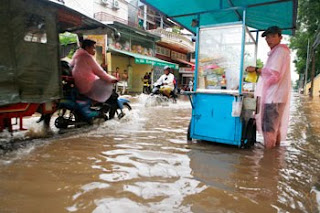
OFFICIALS in Ratanakkiri province said they were prepared to evacuate roughly 2,000 families in two districts where water levels surged to 13 metres Thursday, as a week of wretched weather continued in three provinces across the Kingdom.

Photo by: TRACEY SHELTON A vendor sells sandwiches to motorists amid the downpour in Phnom Penh on Wednesday.

"There has been flooding in five communes within those two districts," said Pav Hamphan, Ratanakkiri's provincial governor. "There will be one more district affected by floods if the rain still falls every day.

" No one had been reported injured as a result of the Ratanakkiri storms.

The head of one of the affected districts said officials were prepared for an evacuation.

"We have six boats prepared for helping victims if the water rises higher," Kong Srun, Lumphat district's governor, told the Post Thursday.

"I think those boats are enough for us because the water isn't rising fast enough to make us worry," he said.

Wet weather nationwide

Three provinces - Ratanakkiri, Kratie and Kampot, where two men drowned earlier this week - have been hit with flooding, said Ly Thuch, deputy president of the National Committee for Disaster Management.

But he said the conditions weren't yet severe enough to spark a countrywide flood alert.

"The water isn't high enough yet," Ly Thuch said. "We will issue an alert when the water reaches 22 metres.

"In Kratie province, water levels had swollen to 17 metres in five districts, said Chen Hong Sry, the province's deputy chief of Cabinet.

Floods in Kratie destroyed almost 2,500 hectares of rice paddies and more than 1,200 homes on Wednesday.

After days of rough weather throughout the country, meteorologists were unable to say Thursday when the rains would end.

"I don't know when it will stop," said Seth Vannareth, director at the Department of Meteorology at the Ministry of Water Resources and Meteorology.

"I will announce later if [the rain] affects more people and when it's expected to end," she added.

Source: Phnom Penh Post Please Click Here

Ambassador Dismisses Rights Hearing as Biased

By Taing Sarada, VOA Khmer
Original report from Washington

Cambodia’s top representative to the United States dismissed as biased a hearing at the US House of Representatives Thursday that is looking into Cambodia’s human rights record.

“We already know that they only invited the opposition party and non-governmental organizations,” Ambassador Hem Heng said in an interview in Washington. “It means that this is a biased hearing.”

The House of Representative’s Tom Lantos Human Rights Commission, co-chaired by Frank Wolf, a Republican from Virginia, and James McGovern, a Democrat from Massachusetts, scheduled a hearing Thursday to address “a concerning trend in the Cambodian government’s overall human rights record.”

Invited were Mu Sochua, a Kampot National Assembly representative for the Sam Rainsy Party who recently lost a defamation suit to Prime Minister Hun Sen; Kek Galabru, founder of the rights group Licadho; and Moeun Tola, head of the Community Legal Education Center’s labor program.

“Normally, the hearing needs to have two sides or more,” Hem Heng said. “But this hearing has only one side participating. So the hearing is trending toward the opposition party.”

International and local observers say Cambodia has seen a decline in media and personal freedoms, with critics of the government facing lawsuits and other charges.

The Cambodian Embassy in Washington released a statement Wednesday saying human rights in Cambodia have been improving.

“We have thousands of civil societies, from of expression, and the unions are progressing,” Hem Heng said. “Among these, there are at least 11 international organizations. Besides those, there is the office of the High Commissioner of the United Nations for human rights.”

Ou Virak, head of the Cambodian Center for Human Rights, said by phone the rights situation in Cambodia has deteriorated over the past four years.

“In 2005, there were some arrests, some complaints, and then the situation was back to normal,” he said. “But in 2009, we see arrests and intimidation.”

Chan Soveth, a rights investigator for Adhoc, said political violence in Cambodia never meets justice.

“The culture of impunity in Cambodia from day to day is accumulating,” he said. “It is scary, and a serious concern.”
Source: Voice Of America Please Click Here

‘Limited’ Freedom in Radio: Broadcaster

By Sok Khemara, VOA Khmer Washington

Cambodia’s airwaves are suffering from limited freedom of expression and political bias, a prominent radio station director said Thursday.

“If we take a look, we don’t clearly know about the freedom of press in Cambodia,” Mam Sonando, who runs Beehive Radio on FM105, told “Hello VOA” during a studio visit to Washington. Speaking only for his own radio station, “freedom of expression exists, but is limited,” he said.

There are limitations on what can be said, while stations friendly to the ruling Cambodian People’s Party seem more able to increase their coverage.
“We’ve asked for permission to do so, but have been turned down,” said Mam Sonando, who is on a fund raising visit to the US.

Twenty radio stations operate in Phnom Penh, with another 25 in the countryside, while nine television stations can be found across the country.

Political observers say the ruling party tends to receive much coverage of development projects and other positive events, helping it at the polls, while opposition parties are often limited to brief media access during campaign periods, a requirement of election law.

Mam Sonando has been jailed twice by the government, most recently in 2005, for programming related to border agreements between Cambodia and Vietnam.

He emphasized the importance of freedom of expression to improve the country, and he allowed the government to allow more.

Source: Voice of America Please Click Here

Inquiries could sink ECCC: PM

Thursday, 10 September 2009 15:03 Vong Sokheng

PRIME Minister Hun Sen on Wednesday predicted that an attempt to charge additional suspects at the Khmer Rouge tribunal would be unsuccessful.

If the push for indictments were to go forward, he said, "the result of the trial would be zero".
"All the suspects would die, and the court would run out of money," he said.

His remarks in Takeo province came one day after the tribunal announced that acting international co-prosecutor William Smith had on Monday formally requested the investigation of five more suspects. Also Monday, Hun Sen repeated in a speech at Chaktomuk Theatre his warning that further investigations risked sparking civil unrest that could claim hundreds of thousands of lives.

On Wednesday, he delivered a message to former Khmer Rouge cadres.

"I would like to appeal to the brotherhood and sisterhood of the former Khmer Rouge to remain calm," he said. "There will not be any problems happening."

Hun Sen also said his statements about the tribunal did not amount to an attempt to influence its work.

"Please go ahead with your procedures. I will not have a say, but the thing is that you need to find a supporting force ... you need four votes," he said in an apparent reference to the Pre-Trial Chamber vote that opened the door to new investigations.

In that vote, announced last week, the five-person chamber failed to resolve a disagreement between the international co-prosecutor, who pushed for more investigations, and the national co-prosecutor, who argued against them. The chamber voted 3-2 against them.

The tribunal's internal rules held that the proposed investigations would go forward in the absence of a supermajority, or 4-1 vote.

Hun Sen's statements about the court this week have drawn concerns about political interference, including from Human Rights Watch, which said Monday that judicial considerations should be based solely on evidence.

Thai Air Commander To Visit After Violations


10 September 2009

Thailand’s chief air marshal, Itthaporn Subhawong, will come to Cambodia next week to meet high-ranking military commanders, following reports that Thai aircraft had crossed as deep as 30 kilometers into Cambodian territory.

The commander of Thailand’s air force will be accompanied by 30 senior officers when he visits Sept. 14, defense officials said.

Thai fighter jets have reportedly flown into Cambodia three times over Pailin province recently, and a reconnaissance plane more than 10 times in the area near Preah Vihear temple, where a military standoff is underway between the neighbors. Prime Minister Hun Sen has warned he could order such flights shot down.

Nevertheless, Cambodian military officials said Itthaporn’s visit would be one of cooperation.

“This visit is very important for the Cambodian and Thai air forces to exchange their experiences with each other and to strengthen their cooperation,” said Chhum Socheath, a spokesman for the Ministry of Defense.

Itthaporn is expected to meet with Cambodian Defense Minister Tea Banh, Pol Saroeun, commander of the Royal Cambodian Armed Forces, and Sin Samnang, commander of Cambodia’s air force.

The delegations “may raise the problem of Thai jet fighters violating Cambodian airspace,” Chhum Socheath said.

Thailand has written official apologies for the violations, claiming they were due to the presence of dark clouds over the border.

Sunday, September 6, 2009

Embattled Obama adviser resigns

Source: BBC News;
A White House adviser has resigned in a row about crude remarks he made about Republicans, and over his signing of a controversial 9/11 petition.
Van Jones, President Obama's adviser on green jobs, had issued two public apologies in the past week.
One of the apologies was for signing a petition in 2001, which suggested the Bush administration may have allowed the 9/11 terror attacks to happen. As he quit, Mr Jones said opponents had "mounted a vicious smear campaign."
The row that has engulfed Van Jones centred on video of a speech he gave before joining the Obama administration, and a petition that questioned whether the Bush administration "may indeed have deliberately allowed 9/11 to happen, perhaps as a pretext for war."

On Friday, President Obama's press secretary failed to give public support to the environmental adviser, saying only that he "continues to work for the administration".

In a media statement, Van Jones said the reason for his resignation was to avoid being a distraction in the Obama administration's efforts to pass healthcare reforms and climate change legislation.

"On the eve of historic fights for health care and clean energy, opponents of reform have mounted a vicious smear campaign against me," he said.

"I cannot in good conscience ask my colleagues to expend precious time and energy defending or explaining my past. We need all hands on deck, fighting for the future," Mr Jones wrote in his resignation letter.

'Extremist views'
Senior Republicans had been demanding Van Jones stand down, with some stating Congress should investigate his "fitness" for the role.

Republican congressman Mike Pence said: "His extremist views and coarse rhetoric have no place in this administration or the public debate."

Van Jones, a former civil rights activist, has been a prominent figure within the environmental movement, and had worked for the White House Council on Environmental Quality since March.

Reports say he had won praise before joining the Obama administration for his vision of a sustainable green economy, one which the Democrats could embrace.

Saturday, September 5, 2009

Land mine victims face bleak prospects: survey

Source: Phnom Penh Post


DISCRIMINATION and poor education are among the factors preventing land mine victims from finding jobs, depriving many of access to basic necessities such as food, water and housing, according to a new survey of land mine survivors.

Nearly three-quarters of survey respondents said they believed land mine survivors were the last to be chosen for jobs, according to a report on the findings from Handicap International titled "Voices from the Ground: Landmine and Explosive Remnants of War Survivors Speak Out on Victim Assistance".

The report, released Wednesday, was tied to the launch of a campaign calling on an upcoming mine action conference to increase assistance to amputees and other land mine survivors. At that conference, to be held in Cartagena, Colombia, Cambodia will present its national strategy for clearing all antipersonnel mines, a requirement under the 1997 Ottawa Treaty.

Whereas Cambodia has made marked improvements in the medical care and physical rehabilitation of land mine survivors, economic integration and employment opportunities are still lagging, according to the report, which drew on the responses of 78 survivors.


Chhay Sorn, a 47-year-old land mine survivor, said in an interview Thursday that the bleak job outlook prompted him to move from his native Kandal province to Phnom Penh five years ago. He now earns between US$1 and $2 each day begging money from tourists on Sisowath Quay.


He said he was injured in a land mine explosion in Pailin while fighting the Khmer Rouge in 1981. After he recovered, an NGO trained him to make artificial legs and wheelchairs, he said, but the money he was able to earn with that training was insufficient, even though he was unmarried and had no children.


"It was very difficult for me to find a job because there is discrimination against crippled men in this society," he said.


More than two-thirds of respondents said they believed economic reintegration opportunities had not improved since 2005, according to the report.


Only 17 percent said they had seen some improvement. But the report noted some progress on the discrimination front: 73 percent said they believed educational and professional discrimination had decreased.


Thong Vinol, executive director of the Disability Action Council, said Thursday that he had also seen a decrease in discrimination, adding that disability legislation adopted and approved earlier this year would be "a key instrument" in reducing it further.
That said, the survey found that discriminatory hiring policies remained in place in government schools, and that the Ministry of Social Affairs, Veterans and Youth Rehabilitation continued to insist that job applicants be "able-bodied".
Officials from the ministries could not be reached for comment Thursday. The report noted that the Education Ministry was "revising its policies".
The survey yielded a particularly dismal assessment of the government pension system, with delayed payments and bribery among the issues reported.
The report warned several times that Cambodia's dependence on external support for disability services might not be sustainable: "Donor fatigue and prospects of reduced aid were considered as challenges to continuing the current level of service provision.
"Heng Ratana, director general of the Cambodian Mine Action Centre, said he had not seen the report, but that Cambodia had "limited resources" and would need to rely on external support for the foreseeable future.
This view was echoed by Chum Bunrong, secretary general of the Cambodian Mine Action and Victims Assistance Authority. "Cambodia is poor.
That's why it needs NGOs to help," he said. The Phnom Penh office of Handicap International Belgium declined to comment in advance of a forthcoming press conference to announce the report's findings.

Three Advocates To Address US Rights Commission

By Men Kimseng, VOA Khmer
Original report from Washington
04 September 2009


Three prominent Cambodians are scheduled as key participants in a US congressional hearing on human rights this month, as concerns persist over the government’s ongoing treatment of dissenters.

Mu Sochua, a Kampot National Assembly representative for the Sam Rainsy Party who recently lost a defamation suit to Prime Minister Hun Sen, is set to join Kek Galabru, founder of the rights group Licadho, and Moeun Tola, head of the Community Legal Education Center’s labor program, in Washington Sept. 10.

“It’s high time that we all talk about the reality there, and we have enough evidence,” said Mu Sochua, who last month was ordered to pay more than $4,000 in fines and compensation after she brought a suit against Hun Sen for allegedly degrading remarks in a speech in April.

The three are scheduled to give testimony to the House of Representative’s Tom Lantos Human Rights Commission, co-chaired by Frank Wolf, a Republican from Virginia, and James McGovern, a Democrat from Massachusetts, examining “a concerning trend in the Cambodian government’s overall human rights record,” according to the commission.

The commission cited as one reason for the hearing a July 29 Washington Post report of “a heightened crackdown on journalists and opposition activists” that “has provoked new concern that the government [of Cambodia] is engaging in widespread abuse of the nation’s legal system to muzzle its detractors.”

It also referred to Mu Sochua’s defamation case, diminished rights for workers and labor, and the eviction of people from their land without compensation.

Mu Sochua said in an interview in Washington Tuesday she would discuss these issues and the suspension of her own parliamentary immunity, along with another SRP colleague, which paved the way for two lawsuits.

“I would like to make it clear that the Sam Rainsy Party will not make an appeal to cut aid to Cambodia, so the Cambodian people should not worry about this,” Mu Sochua said. “We are here at the US Congress to provide truth about a grave situation that might affect democracy and human rights in Cambodia.”

Kek Galabru said she will ask the US to assist Cambodia in ensuring its courts are made independent and in finding ways to tackle land issues.

“The land issue is very important because it is the life and bread of some 80 percent of Cambodians living in rural areas,” she said by phone Wednesday.

“The US should help find a way to distribute land in a fair manner to ensure good, successful and positive developments where the majority of people benefit, not just a small group, leaving the majority in tears,” she said.

Meanwhile, shorter work contracts for workers after a US quota program ended and suits filed against labor leaders are a concern, said Moeun Tola, adding “past killings of [union leaders] have never been solved…which is a threat to the freedom of unions.”

The rights commission hearing was announced Aug. 25, and its examination of the situation in Cambodia is a rare instance. Along with the Cambodians invited are representatives from the US State Department.

“I am sorry that the commission only invited an opposition team, without inviting another side…to give a balanced report and find out the truth for a solution,” said Koy Kuong, a spokesman for the Ministry of Foreign Affairs.

That the administration was not invited was “not fair, not neutral, and biased,” he said. “It won’t help promote human rights.”

Cambodia’s own human rights committee, headed by senior Hun Sen adviser Om Yienteng, was not aware of the hearing.

Om Yentieng, contacted Monday, said the government had not broken any laws in pursuing lawsuits against Mu Sochua and others.

“When they sue us, they push us to the court, but once we countersue, they tell us not to and ask us to leave them to exercise their freedom of expression,” he said. “I think that we should have a clear grammar for democracy. We should not use democracy wrongly and out of grammar, causing people to copy a bad example.”
To hear the Khmer audio version of any story below, first click on the headline, then click on the speaker icon. For more stories, click here.

Blast Targets German Troops in Afghanistan

By VOA News
05 September 2009


A roadside bomb exploded Saturday near a convoy of German troops in northern Afghanistan, a day after German military commanders ordered a NATO airstrike in the region, killing up to 90 people, many of them civilians.
Authorities say the blast damaged vehicles, but there are no report of any serious injuries from Saturday's explosion.
NATO is calling for an investigation of Friday's air strike that blew up two fuel trucks in a massive explosion.

The pre-dawn strike was ordered by German military commanders after fuel trucks that had been hijacked earlier by Taliban militants were spotted on a river bank in the Northern Kunduz province, surrounded by what appeared to be insurgents, in the process of unloading the tankers.

German officials say the order to attack was given because the trucks could be used as weapons in a suicide attack against nearby German troops.
Afghan President Hamid Karzai and the NATO command in Afghanistan are promising full investigations into the civilian deaths.
Mr. Karzai issued a statement saying "targeting civilians is unacceptable."
Provincial officials say the strike killed 56 Taliban militants and a large number of civilians, including children who had been called to the area by the Taliban members to remove fuel from the tankers.
An Interior Ministry spokesman, Zemarai Bashary, said the government is working to confirm civilian casualties.
White House spokesman Robert Gibbs expressed concern about the reports of civilian deaths. Afghan civilian deaths during foreign military operations have caused resentment among the public.U.S.
Army General Stanley McChrystal ordered U.S. and NATO troops in July to limit the use of air strikes to try to reduce such casualties.
U.S. military commanders say protecting Afghan civilians and providing security is a focal point of the Obama administration's revamped strategy in Afghanistan.

Wednesday, August 12, 2009

Sam Rainsy Party MP’s son gunned down

August 12, 2009
Chrann Chamroeun

The son of an opposition parliamentarian was shot dead late Sunday after an unresolved traffic accident near Wat Botum park.

Yont Thauron, the son of Sam Rainsy Party lawmaker Yont Tharo, was shot after his car was involved in a minor traffic accident while returning from a wedding. Three of Yont Thauron’s friends also suffered gunshot wounds and remain in critical condition at Calmette hospital.


“It was a cruel and brutal crime,” said Yont Tharo at Kandal province’s Wat Samrong Andeth on Monday, where family and friends gathered to mourn the 25-year-old military police officer. “They shouldn’t have used guns to attack my son and his friends, who were not armed, over a minor traffic accident that could have been resolved peacefully.”


Photo by: Heng Chivoan
A woman mourns the death of Yont Thauron,
son of SRP lawmaker Yont Tharo,
who was shot Sunday after a traffic accident.
According to the police report, Yont Tharo said, his son’s Lexus collided with a number of motorbikes near Wat Botum park, and Daun Penh district police arrived on the scene to mediate the dispute that ensued.

A few minutes after the accident, Yont Thauron was gunned down at a noodle stall across from the park.

He added: “Police told me that they have already identified the perpetrators … some of whom are also police officials, who used licensed guns to attack my son and his three friends.”

SRP spokesman Yim Sovann said that the “brutal” shooting reflected the decrease in social morality, and that authorities should bring theperpetrators to justice.

“We are calling for authorities to arrest perpetrators and punish them comprehensively to give justice to victims’ families and give trust to all people in the security guaranteed by Cambodian Constitutional law.”

Phnom Penh Municipal Police Chief Touch Naruth said that police were “burning their hands and legs” to find the perpetrators, which he said have been identified by police. “As soon as we arrest them, we will send them to court to charge them,” he said.

Daun Penh district police chief Yim Socheat could not be reached for comment Monday. Yont Tharo said that following the traditional funeral at Wat Samrong Andeth, the body was set to be cremated at 6pm Monday.

Source: www.phnompenhpost.com

Blog List